We Ranked The 5 Best Probiotics for Dogs With Diarrhea & Sensitive
Stomach (2026)
Most formulas are missing the same 2–3 things. One isn't.
by Sarah Lowell at HealthyPetReview.com
Most dog probiotics do one thing — add bacteria to the gut.
If your dog had one bad day, that might be all they need.
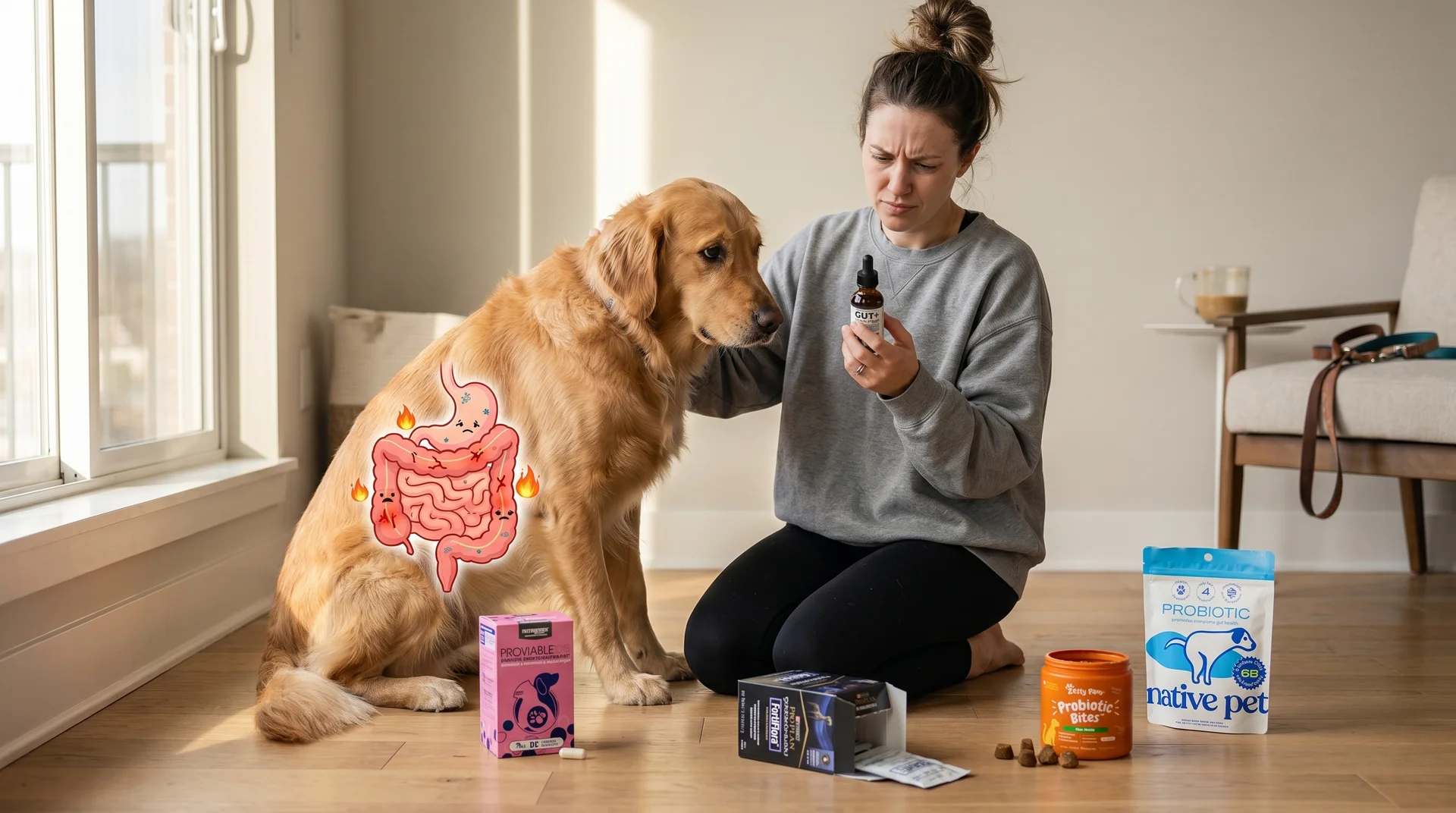
But if the diarrhea keeps coming back,
probiotic bacteria alone aren't solving it.
The gut is too irritated to hold onto them.
They pass through, things improve for a few days, and then you're back
to square one.
A formula that actually works long-term has to do more than add
probiotic bacteria.
It has to fix what’s wrong with the gut itself.
That means a formula that covers four layers:
1
Probiotic Bacteria
Seeds the gut with good strains
2
Prebiotic
Feeds the bacteria so they survive
3
Gut Lining Repair
Seals the wall so bacteria stay put
4
Anti-Inflammatory
Calms the irritation so progress holds
Here’s what to look for.
Look For
Multiple Strains
One strain covers one narrow function. Look for 4–7 named
species — not a "proprietary blend" with no details.
A Prebiotic
Probiotic bacteria without food die. Chicory root inulin or FOS
feeds the strains after they arrive. Without it, they pass
through.
Gut Lining Repair
If diarrhea keeps cycling back, the gut wall is damaged.
L-Glutamine and collagen help seal it. Most probiotics don't
include either.
Anti-Inflammatory
Chronic inflammation undoes what probiotics build. Turmeric and
PEA calm it. The difference between "it's working" and "it's
still working three months later."
Avoid
Single-Strain "Complete" Formulas
One strain at 100M CFU is a starting point, not a solution — no
matter how well-known the brand.
High CFU With No Prebiotic
6 billion bacteria with nothing to feed on. They arrive, die,
pass through. Two weeks later, loose stool is back.
"Gut Health" Claims With No Label Proof
Some products say "supports gut health" on the bag but list no
repair ingredients in the Guaranteed Analysis. Marketing copy
isn't the label.
Soft Chews With Heat-Sensitive Strains
Baking kills live bacteria before the product reaches your dog.
Multiple Amazon batches show quality inconsistency.
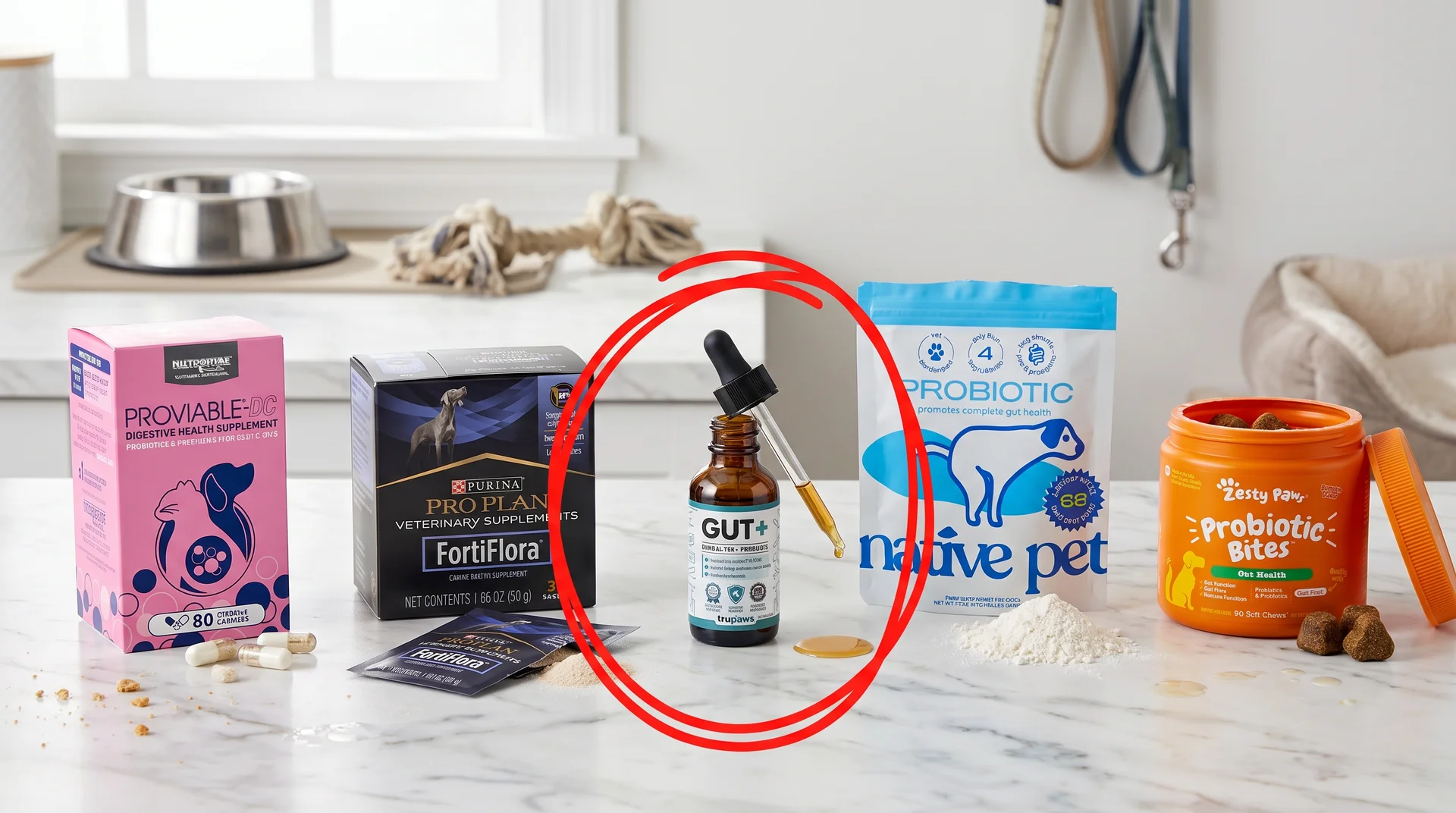
Every product on this list covers at least one thing on the left. Only
one covers all four. Here's how they compare.
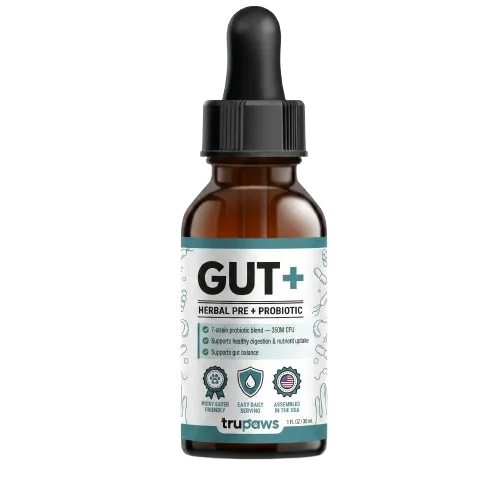
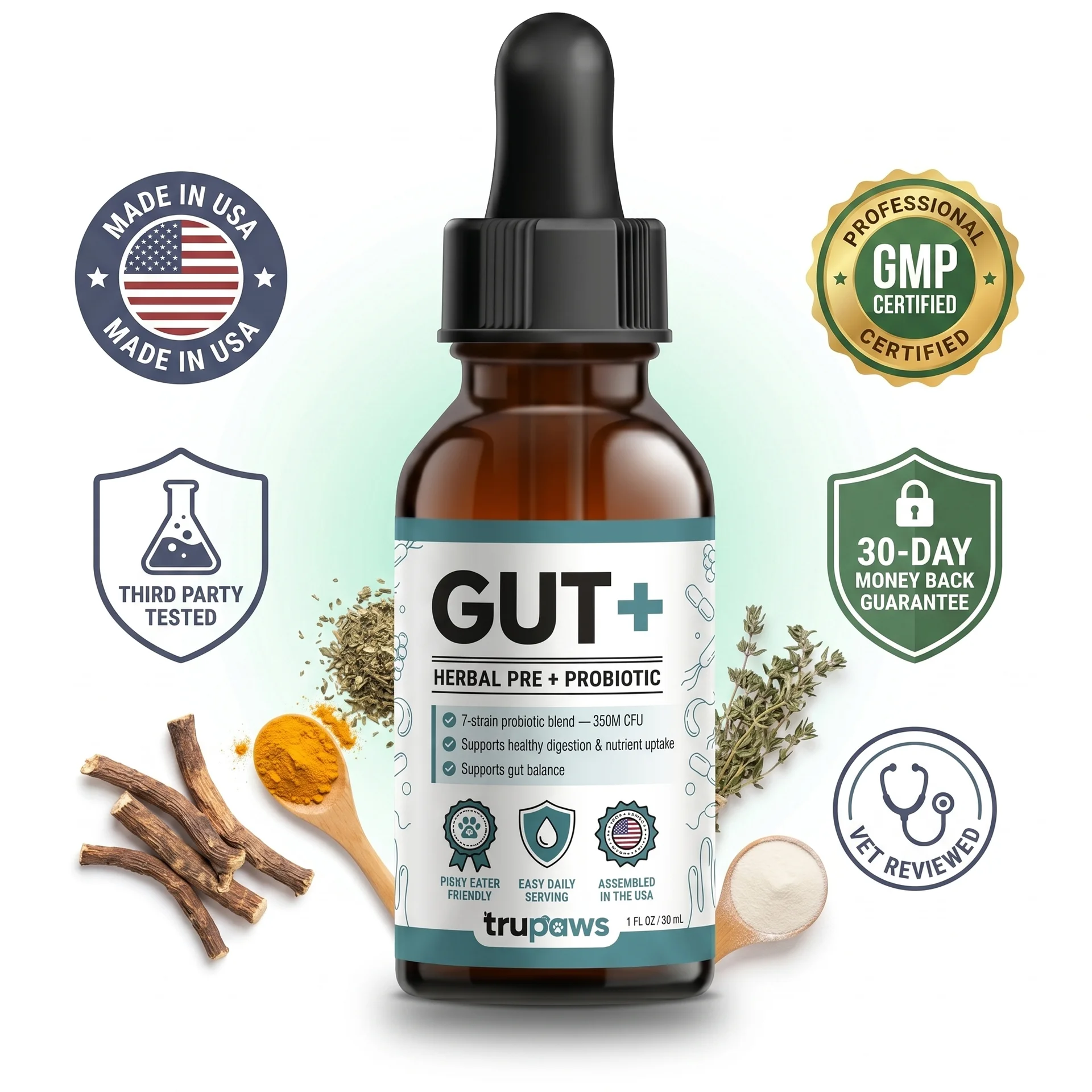
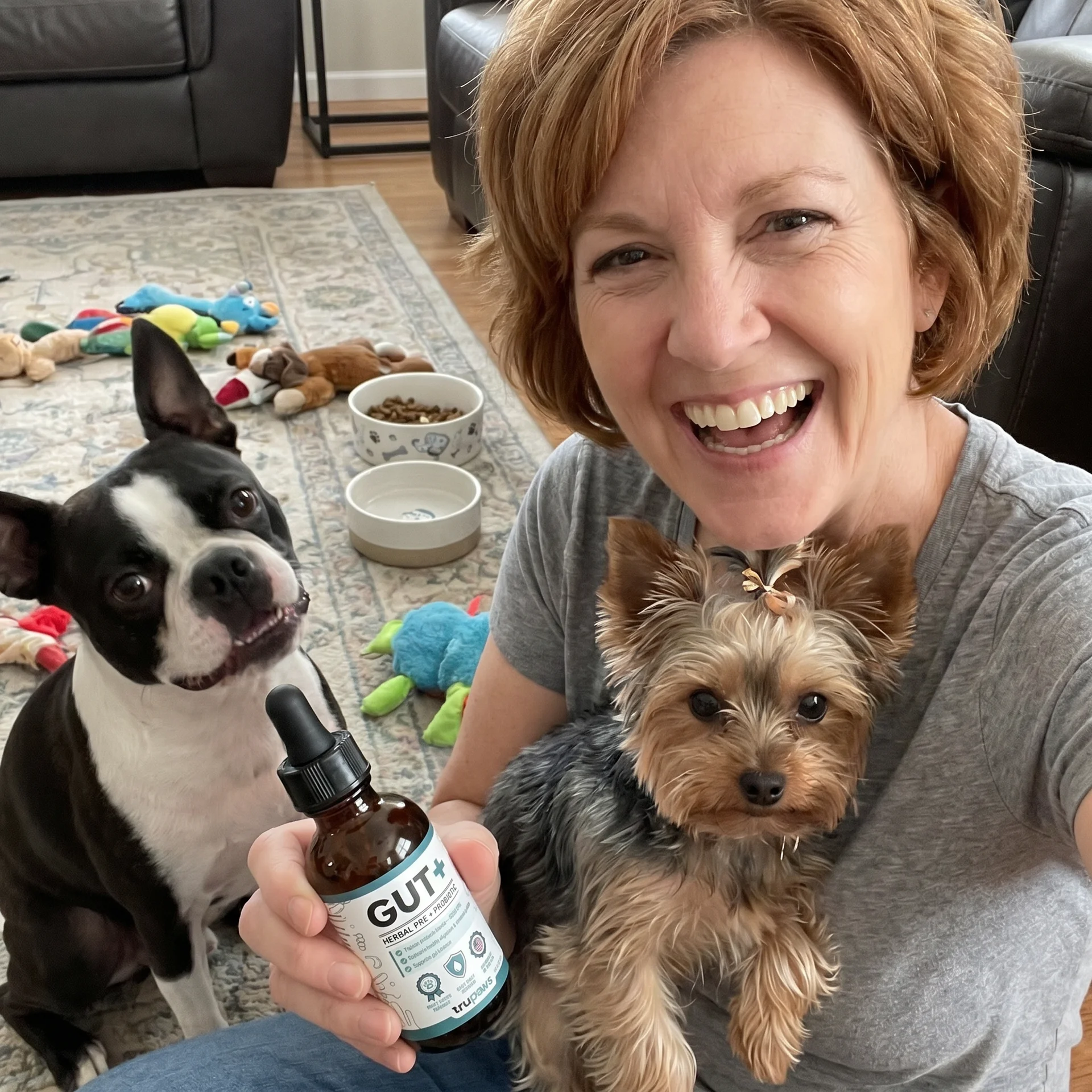
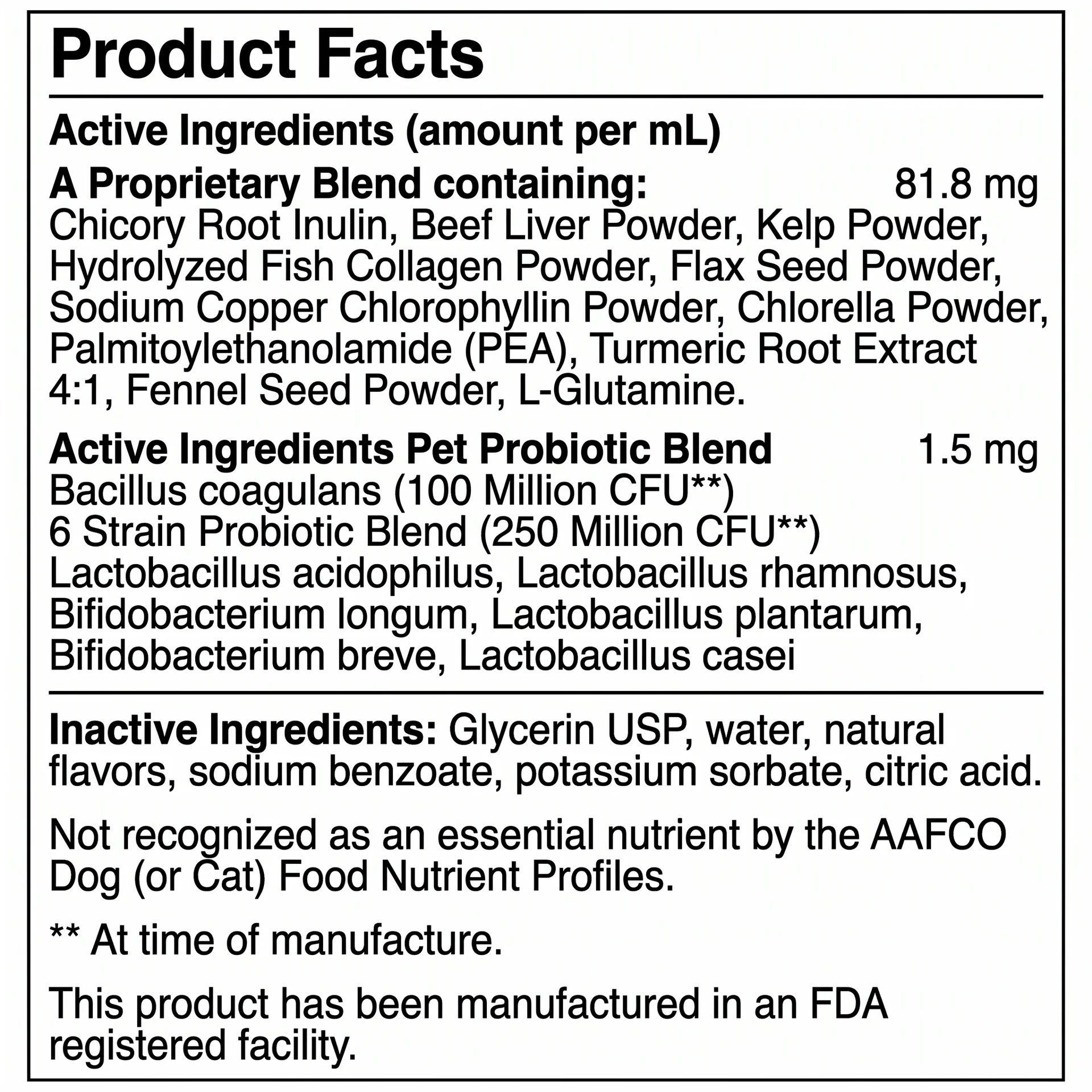
Only formula with gut lining repair (L-Glutamine + collagen)
Only formula with anti-inflammatory support (PEA + turmeric)
7 strains incl. spore-forming Bacillus coagulans
Chicory root inulin prebiotic
Liquid format — works for picky eaters
Weight-based dosing, not one-size-fits-all
CONS
Requires refrigeration after opening
Only available on brand site (not Amazon)
Newer brand — less name recognition
The Bottom Line
Every other product on this list adds probiotic bacteria and
stops.
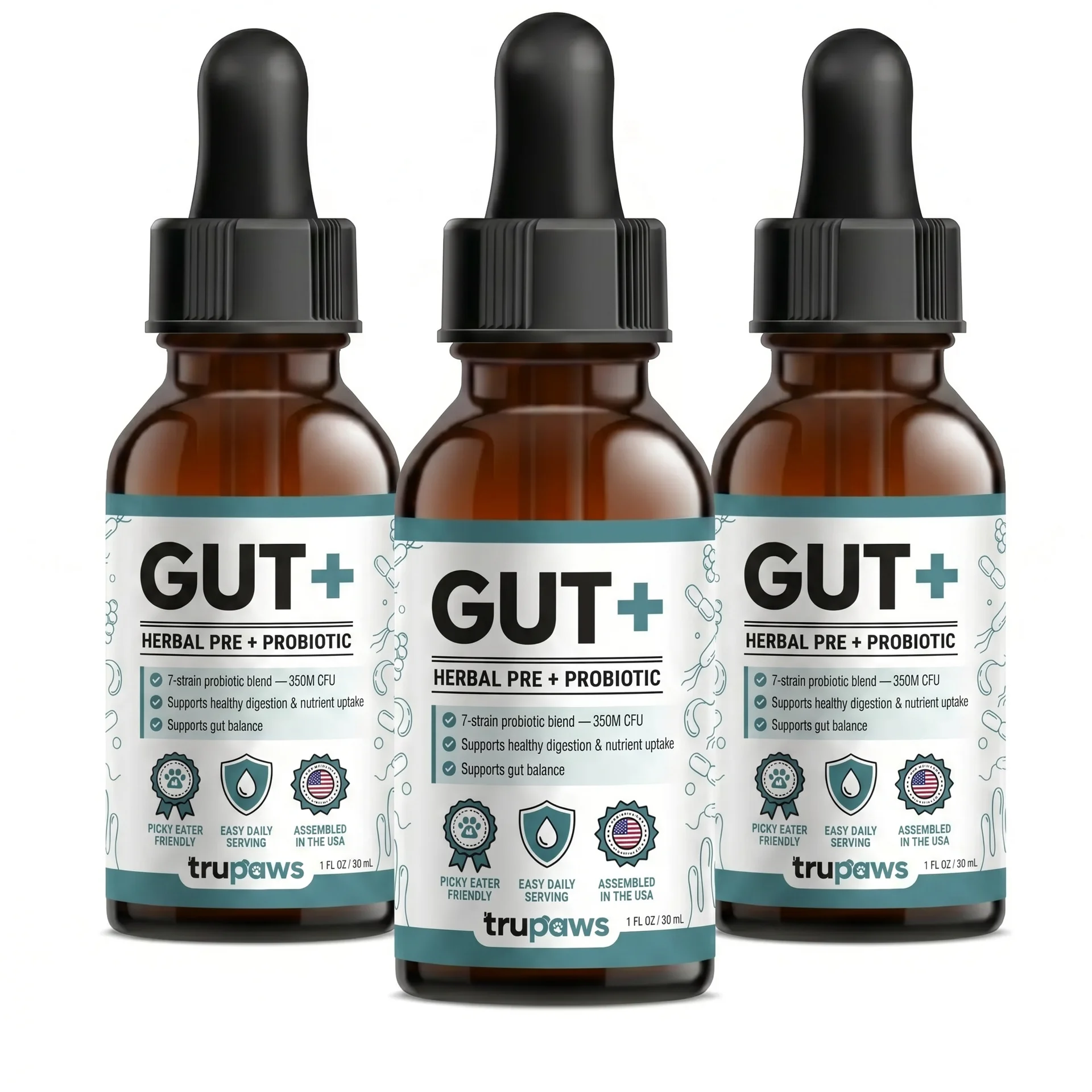
GUT+ adds bacteria, feeds them,
repairs the gut lining they land on, and calms the
inflammation underneath.
Four layers. Nobody else does all four.
The bacteria include Bacillus coagulans — a spore-forming strain
that
survives stomach acid alive.
That matters more than a big CFU number on the label.
Liquid dropper. Dose by weight. Most dogs don’t notice it in
their food.
It needs refrigeration after opening. Good.
If a probiotic sits on a shelf at room temperature and claims
to be alive, ask yourself what’s actually in there.
$1.00/day. Same price as FortiFlora. Except FortiFlora gives
you one layer. This gives you four.
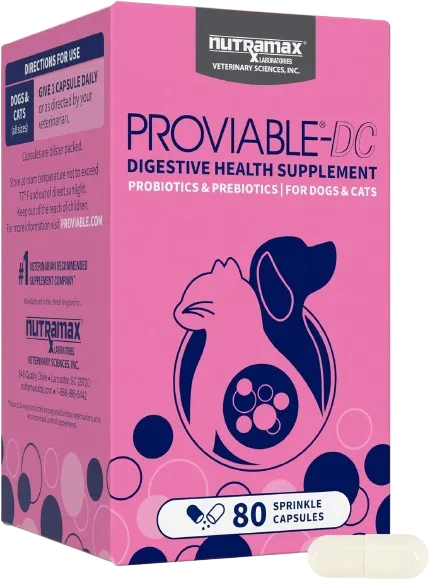
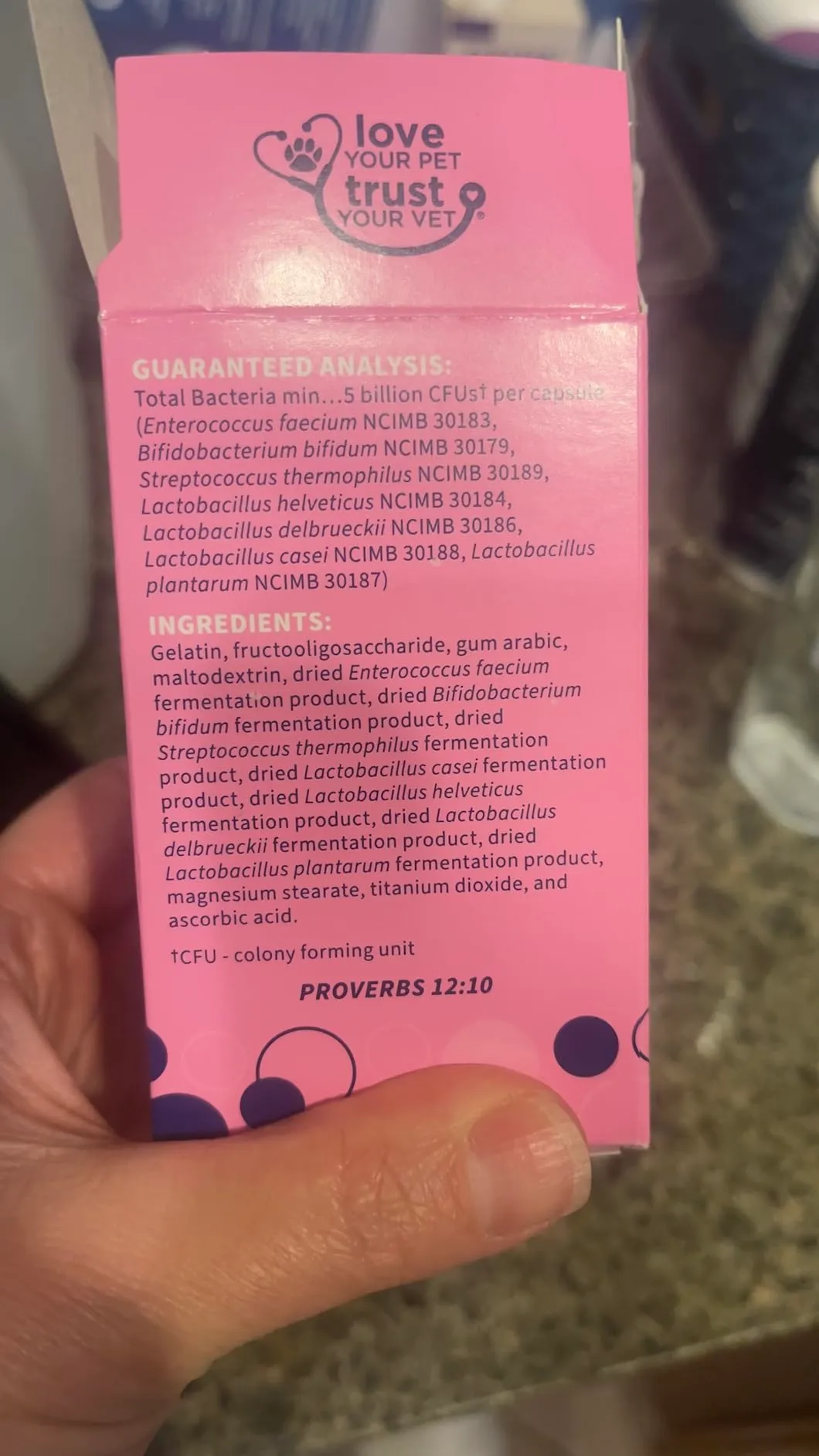
This is the one your vet knows by name. Seven strains, every
single one published with NCIMB identification numbers. FOS
prebiotic listed as the first active ingredient — not buried at
the bottom. At $0.65/day, it’s the most affordable vet-grade
option on this list.
Proviable does two things well:
it seeds the gut with bacteria and feeds them.
That’s layers one and two.
What it doesn’t do: repair the gut lining or reduce
inflammation. If your dog got better on Proviable for a few
weeks and then slid back —
the bacteria arrived, but the damaged gut couldn’t hold onto
them.
That’s layers three and four. They’re not in this formula.
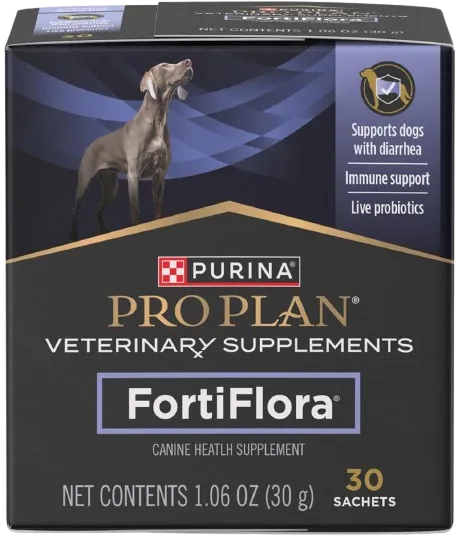
3: FortiFlora
by Purina Pro Plan Veterinary
★★★★★
Based on 4.7 Average Reviews (46,000+)
B-
Rating
Formula Completeness
4.5/10
Effectiveness
7.0/10
Ease of Use
9.2/10
Value per Dollar
5.5/10
PROS
Most studied single-strain canine probiotic
Extremely palatable — dogs love the liver flavor
#1 vet-recommended brand name
Microencapsulated for stomach acid survival
Easy to use — one sachet, sprinkle, done
CONS
1 strain, 100M CFU — lowest on this list
No prebiotic
No gut lining repair
No anti-inflammatory
~$1.10/day — most expensive for what is inside
Same sachet for every dog regardless of size
The Bottom Line
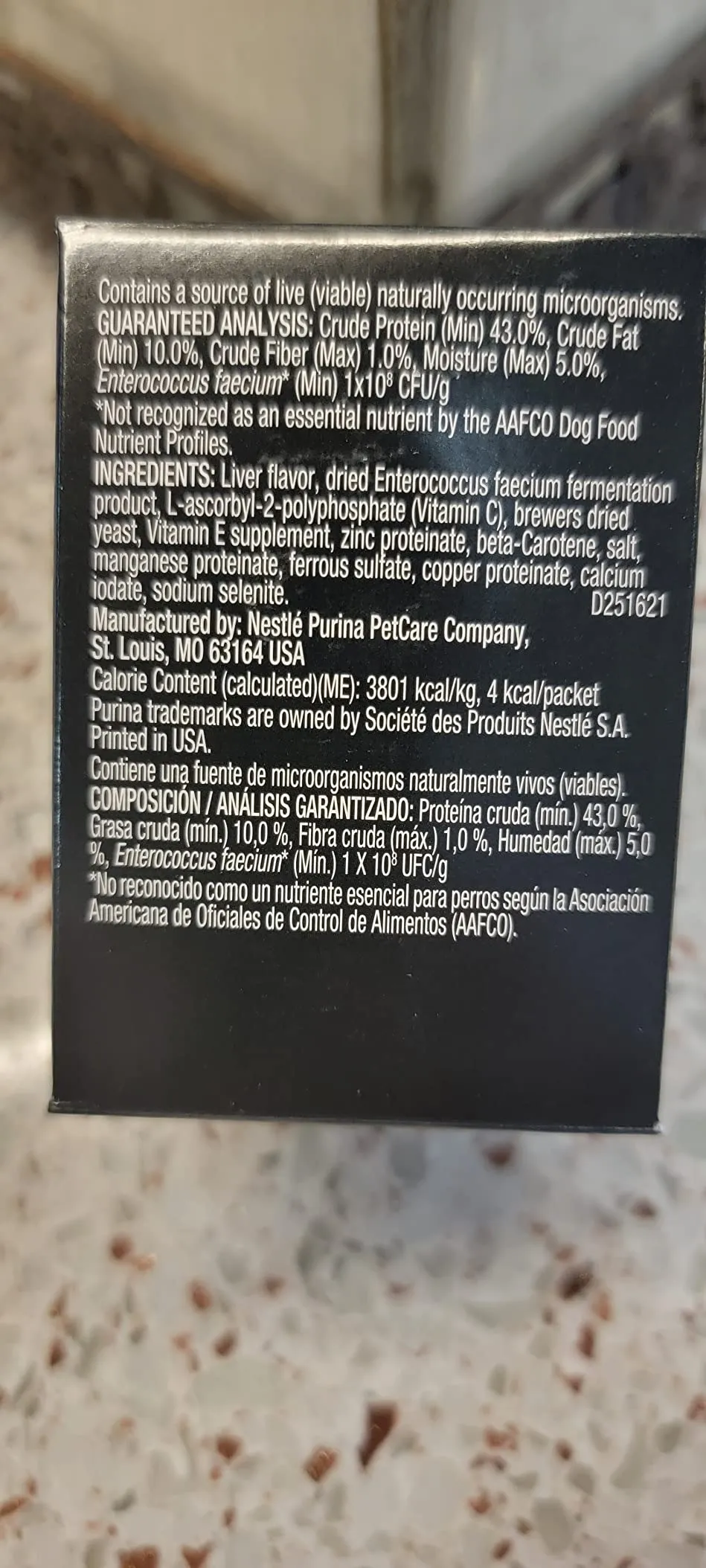
Your vet handed you this. You trusted it. And for a dog that ate
something bad and had one rough night, it works fine. One strain
— Enterococcus lactis SF68 — with more published canine research
behind it than anything else on the market. Dogs love the taste.
But here’s the issue:
the formula hasn’t changed in years.
One strain. 100 million CFU. No prebiotic. No gut lining repair.
No anti-inflammatory. It covers one of the four criteria on this
page.
At $1.10/day,
FortiFlora is the most expensive product on this list
relative to what’s actually inside the sachet.
If it had already fixed the problem, you probably wouldn’t be
reading a comparison page right now.
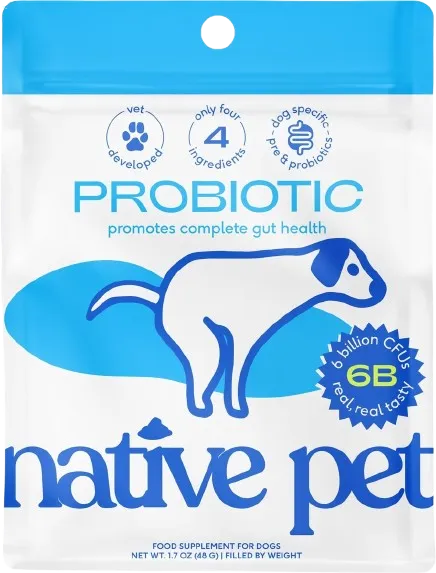
4: Native Pet Probiotic
by Native Pet
★★★★½
Based on 4.5 Average Reviews (Amazon)
C+
Rating
Formula Completeness
6.5/10
Effectiveness
7.5/10
Ease of Use
7.5/10
Value per Dollar
7.0/10
PROS
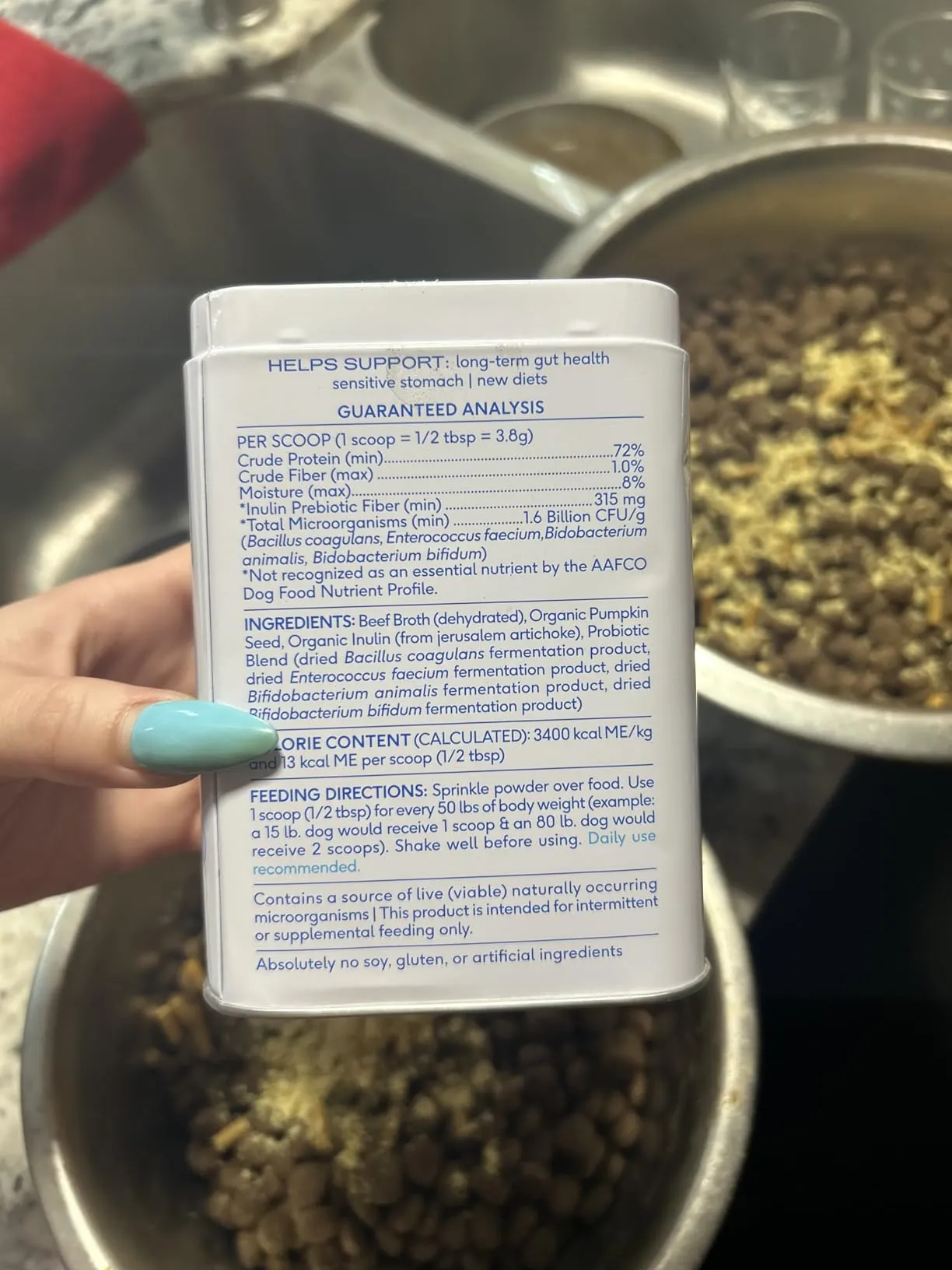
Cleanest ingredient list — no synthetic additives
6B CFU per scoop
Dual prebiotics (inulin + pumpkin seed)
Beef bone broth base — palatable
Affordable for small dogs (~$0.50/day)
CONS
No published strain IDs
Gut lining claim not backed by label
No anti-inflammatory ingredients
Cost doubles for large dogs (2 scoops)
Must be served immediately once mixed
The Bottom Line
If you care about clean ingredients above everything else,
Native Pet wins. No titanium dioxide. No animal digest. No
synthetic fillers. Beef bone broth base that dogs actually want
to eat. Four strains at 6 billion CFU with dual prebiotics.
That’s a solid two-layer formula.
One thing we noticed: the Amazon listing says bone broth
“supports the gut lining.”
We checked the Guaranteed Analysis. No L-Glutamine. No
collagen. No dedicated repair ingredient listed.
Trace amounts in dehydrated broth powder and a marketing claim
are not the same thing.
Also worth noting:
Native Pet doesn’t publish specific strain IDs.
You can’t verify which exact bacteria you’re giving your dog.
For a brand that sells itself on transparency, that’s a gap.
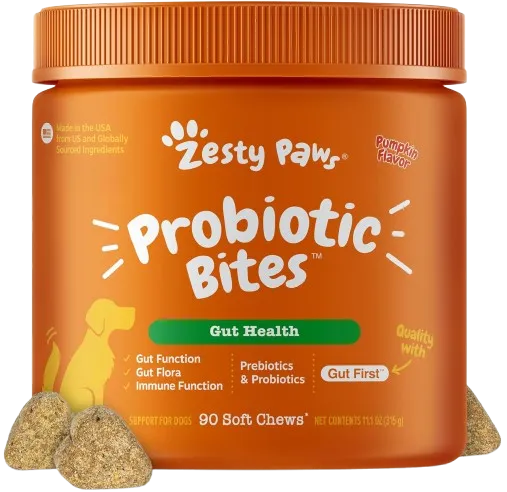
5: Probiotic Bites
by Zesty Paws
★★★★☆
Based on 4.4 Average Reviews (Amazon)
C
Rating
Formula Completeness
5.5/10
Effectiveness
6.0/10
Ease of Use
9.5/10
Value per Dollar
7.5/10
PROS
Cheapest option ($0.31 - $1.07/day)
Soft chew — easiest format to give
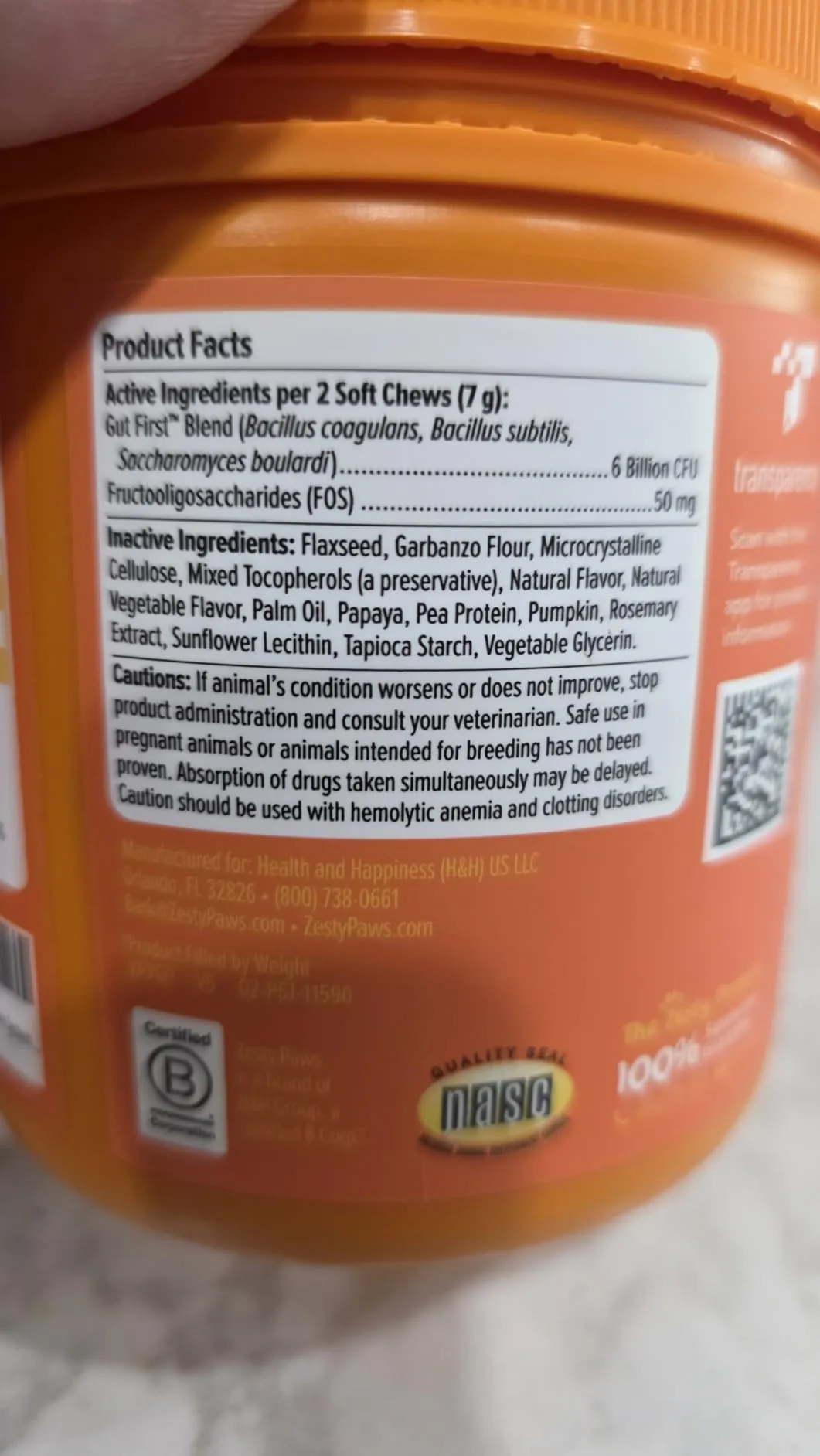
6B CFU per chew
Includes FOS prebiotic
NASC Quality Seal
CONS
Two different formulas on shelves right now
No gut lining repair
No anti-inflammatory
Heat-sensitive — batch quality varies
Only 50mg FOS per chew (minimal)
The Bottom Line
Amazon’s bestselling dog probiotic. $0.31/day for a small dog.
Soft chew format — most dogs eat it like a treat. If you want
the cheapest way to add probiotic bacteria, this is it.
Two red flags.
There are currently two different Zesty Paws formulas
circulating across retailers
— the older version had 6 strains at 3 billion CFU, the current
has 3 strains at 6 billion. Check the jar you receive. They are
not the same product.
Second: soft chews are baked.
Heat kills live bacteria.
Several Amazon reviews report texture differences and quality
variation between batches. At this price point, you’re getting
bacteria and a light prebiotic — 50mg of FOS, which is minimal.
Nothing for gut repair. Nothing for inflammation.
4 months on FortiFlora didn't fix it. 5 days on this did.
Our golden retriever Bailey had chronic loose stool for almost a
year. Vet put her on FortiFlora — it helped for maybe two weeks then
she'd flare right back up. Tried doubling the dose. Same thing. I
was Googling at 2am when I found this page and figured why not.
Day 3, her stool started firming up. Day 5, first solid poop in
months.
We're 11 weeks in now and she's had exactly one bad day — the day
she ate half a stick in the yard. That's on her, not the
probiotic.
The liquid is easy. I just squeeze the dropper into her food and
she doesn't even notice. I genuinely think the difference is that
this one actually repairs the gut instead of just adding bacteria to
a broken system.
David T.
✓ Verified Purchase
★★★★★
2 years of rotating probiotics. This is the first one that held past
week 3.
Rex is a 90lb German Shepherd with IBD. We've been through the full
rotation — Proviable for 6 months (helped then stopped), FortiFlora
(barely noticed a difference), Native Pet (worked for about 3 weeks
then right back to pudding stools at 4am). I was honestly starting
to accept this was just his life.
Started GUT+ as a last-resort.
Week 1, marginal improvement. Week 2, noticeably firmer. Week 3 —
the week everything usually falls apart — it held. We're on month
4 now.
I think
what's different is the L-Glutamine and the anti-inflammatory stuff.
His gut was so damaged from two years of chronic inflammation that
bacteria alone couldn't stick. Once the lining started healing,
everything else followed.
Jessica M.
✓ Verified Purchase
★★★★★
My Frenchie spit out every chew and capsule. She doesn't even notice
this.
Lola is the pickiest eater I've ever met. She ate around the Zesty
Paws chews. She crunched the Proviable capsule open once, tasted the
powder, and literally walked away from her bowl. I tried hiding them
in peanut butter, cheese, pill pockets — she found them every
time.
The
liquid dropper changed everything.
I squeeze it into her wet food, stir it in, and she eats the
whole bowl without hesitating.
No tricks, no wrestling, no wasted supplements at the bottom of the
dish.
Her
stool firmed up within the first week. We're 6 weeks in and I'm not
cleaning up accidents anymore. For any Frenchie or bully breed owner
dealing with sensitive stomachs — this format is the move.
Frequently Asked Questions
My dog has been on FortiFlora for months and still flares up. Why?
+
FortiFlora adds one bacterial strain that helps with acute
diarrhea. But it doesn't include a prebiotic to sustain those
bacteria, anything to repair the gut lining, or anti-inflammatory
support. If the diarrhea keeps cycling, the bacteria are arriving
but the gut environment can't hold onto them. GUT+ addresses all
four layers — strains, prebiotic, lining repair, and inflammation
— which is why owners often switch after FortiFlora alone
plateaus.
Proviable helped for a while then stopped working. What happened?
+
Proviable seeds and feeds the gut well — 7 strains plus FOS
prebiotic. But if the gut wall is damaged from months of chronic
inflammation, new bacteria leak back out. Proviable doesn't
include gut lining repair or anti-inflammatory ingredients. That's
the gap. GUT+ adds L-Glutamine, collagen, PEA, and turmeric
specifically for this.
Why is the CFU count lower than competitors?
+
GUT+ includes Bacillus coagulans, a spore-forming strain that
survives stomach acid, heat, and shelf storage without
refrigeration. Most non-spore strains die before reaching the
intestine — a bigger number on the label doesn't mean more
bacteria doing the work inside your dog. What survives to the gut
is what counts.
My dog spits out chews. Will they take this?
+
GUT+ is a liquid with a beef liver flavor base. Drop it directly
in the mouth or mix it into wet or dry food. It doesn't change the
taste or texture of the meal. Most owners say their dog doesn't
notice it.
How long until stool firms up?
+
Most owners see noticeable improvement in 3–7 days. Full gut
stabilization — where the good weeks become the norm instead of
the exception — typically takes 2–4 weeks of daily use.
What if it doesn't work?
+
30-day money-back guarantee. Keep the opened bottle, return any
unopened ones. If your dog's stool isn't noticeably firmer, full
refund. No questionnaire, no hoops.
References
Weese & Martin (2011). Assessment of commercial probiotic
bacterial contents and label accuracy. Can Vet J. · Schmitz &
Suchodolski (2016). Understanding the canine intestinal microbiota.
Vet Med Sci. · Xu et al. (2021). Evaluation of label claims of
commercial pet probiotics. JVIM. · Gomez-Gallego et al. (2016). Novel
probiotic strategies for intestinal inflammation. Beneficial Microbes.
Privacy Policy
Last Updated: May 2026
HealthyPetReview.com ("we," "us," or "our")
operates the website located at HealthyPetReview.com (the "Site"). This
Privacy Policy describes how we collect, use, disclose, and protect your
personal information when you visit or interact with the Site.
1. Information We Collect
Information You Provide Directly:
We may collect your name, email address, and any other information you
voluntarily submit through contact forms, comment sections, or email
correspondence.
Information Collected Automatically:
When you visit the Site, we automatically collect certain information
including your IP address, browser type and version, operating system,
referring URLs, pages viewed, time and date of visits, time spent on
pages, and other diagnostic data.
Cookies and Tracking Technologies:
We use cookies, web beacons, pixels, and similar tracking technologies
to collect information about your browsing behavior. This includes
first-party cookies for site functionality and analytics, third-party
cookies from advertising partners and analytics providers (including
Google Analytics, Facebook Pixel, and similar services), and tracking
pixels embedded in emails (if applicable). You can control cookie
preferences through your browser settings. Disabling cookies may affect
site functionality.
2. How We Use Your Information
We use collected information to operate, maintain, and improve the Site;
analyze traffic patterns and user behavior; deliver and measure the
effectiveness of advertising; respond to your inquiries and
communications; comply with legal obligations; and detect, prevent, and
address technical issues or fraud.
3. How We Share Your Information
We do not sell your personal information. We may share information with
the following categories of third parties:
Analytics Providers: Google
Analytics and similar services that help us understand site traffic and
usage patterns.
Advertising Partners:
Advertising networks and platforms (including Google Ads, Meta/Facebook
Ads) that help us deliver and measure advertising.
Affiliate Partners: When you
click on product links, our affiliate partners (including TruPaws) may
collect information about your click and any subsequent purchase for
commission tracking purposes.
Service Providers: Hosting
providers, email service providers, and other vendors that help us
operate the Site.
Legal Requirements: We may
disclose information if required by law, court order, or governmental
regulation, or if we believe disclosure is necessary to protect our
rights, your safety, or the safety of others.
4. Third-Party Links
The Site contains links to third-party websites, including product pages
and retailer sites. We are not responsible for the privacy practices or
content of these external sites. We encourage you to read the privacy
policies of any third-party site you visit.
5. Data Retention
We retain personal information for as long as necessary to fulfill the
purposes described in this policy, comply with legal obligations,
resolve disputes, and enforce our agreements. Automatically collected
data is typically retained for 26 months unless a longer retention
period is required by law.
6. Data Security
We implement commercially reasonable technical and organizational
measures to protect your personal information against unauthorized
access, alteration, disclosure, or destruction. However, no method of
electronic transmission or storage is 100% secure, and we cannot
guarantee absolute security.
7. Your Rights and Choices
Access and Correction: You may
request access to or correction of your personal information by
contacting us. Deletion: You
may request deletion of your personal information, subject to certain
legal exceptions.
Opt-Out of Tracking: You can
opt out of Google Analytics tracking by installing the Google Analytics
Opt-Out Browser Add-on. You can manage ad preferences through the
Digital Advertising Alliance opt-out page (optout.aboutads.info).
Do Not Track: We currently do
not respond to Do Not Track browser signals.
8. California Privacy Rights (CCPA/CPRA)
If you are a California resident, you have additional rights under the
California Consumer Privacy Act and California Privacy Rights Act,
including the right to know what personal information we collect and how
it is used, the right to request deletion of personal information, the
right to opt out of the sale or sharing of personal information (we do
not sell personal information), and the right to non-discrimination for
exercising your privacy rights. To exercise these rights, contact us
using the information below.
9. Children's Privacy
The Site is not directed to individuals under the age of 13. We do not
knowingly collect personal information from children under 13. If we
become aware that we have collected personal information from a child
under 13, we will take steps to delete that information promptly.
10. Changes to This Policy
We may update this Privacy Policy from time to time. The "Last Updated"
date at the top reflects the most recent revision. Continued use of the
Site after changes constitutes acceptance of the updated policy.
11. Contact Us
If you have questions about this Privacy Policy or wish to exercise your
privacy rights, contact us at:
privacy@healthypetreview.com
Terms & Conditions
Last Updated: May 2026
These Terms and Conditions ("Terms") govern your access to and use of
HealthyPetReview.com (the "Site"). By accessing or using the Site, you
agree to be bound by these Terms. If you do not agree, do not use the
Site.
1. Nature of Content
The Site publishes editorial content, product reviews, and comparisons
related to pet health supplements. Content on this Site is for
informational and educational purposes only
and does not constitute veterinary advice, medical advice, or
professional consultation. All product reviews and comparisons reflect
the opinions of the authors based on publicly available information,
product labels, and aggregated consumer reviews. Individual results may
vary.
2. Affiliate and Sponsored Relationships
HealthyPetReview.com participates in affiliate marketing programs. This
means we may receive compensation when you click on links to products
featured on this Site and make a purchase. Specifically: We have a paid
financial relationship with TruPaws, the manufacturer of GUT+ by
TruPaws. Product rankings and reviews may be influenced by compensation
arrangements. Affiliate commissions do not affect the price you pay for
any product. We are committed to providing honest assessments, but
readers should be aware of our financial relationships when evaluating
our recommendations.
3. No Veterinary or Medical Advice
Nothing on this Site should be interpreted as veterinary advice, a
diagnosis, or a treatment recommendation. The information provided is
not a substitute for professional veterinary care.
Always consult a licensed veterinarian
before starting, stopping, or changing any supplement, medication, or
treatment regimen for your pet. Do not disregard professional veterinary
advice or delay seeking it because of something you read on this Site.
4. Product Claims and FDA Disclaimer
The products discussed on this Site are dietary supplements for animals.
These statements have not been evaluated by the Food and Drug
Administration (FDA).
Products discussed are not intended to diagnose, treat, cure, or prevent
any disease. Efficacy claims are based on manufacturer-provided
information, published research where cited, and aggregated consumer
reviews. We do not independently verify all manufacturer claims.
5. Accuracy of Information
We make reasonable efforts to ensure accuracy of product information,
ingredient lists, pricing, and review data. However, product
formulations, prices, and availability may change without notice. We do
not guarantee that all information on the Site is current, complete, or
error-free. We recommend verifying product details directly with the
manufacturer or retailer before making a purchase.
6. Intellectual Property
All content on this Site — including text, graphics, logos, images, and
software — is the property of HealthyPetReview.com or its content
licensors and is protected by applicable intellectual property laws. You
may not reproduce, distribute, modify, or create derivative works of any
content without prior written consent.
7. User Conduct
You agree not to use the Site in any way that violates applicable laws
or regulations, infringes on the rights of others, introduces malware or
other harmful code, attempts to gain unauthorized access to the Site or
its systems, or uses automated tools to scrape or harvest content
without permission.
8. Third-Party Links and Products
The Site contains links to third-party websites and products. We do not
control, endorse, or assume responsibility for the content, privacy
policies, or practices of any third-party sites. Your interactions with
third-party sites and purchase of third-party products are governed by
those parties' own terms and policies.
9. Limitation of Liability
To the maximum extent permitted by law, HealthyPetReview.com, its
owners, operators, authors, and affiliates shall not be liable for any
direct, indirect, incidental, special, consequential, or punitive
damages arising from your use of or inability to use the Site, any
content on the Site, any products purchased through links on the Site,
or any actions taken based on information provided on the Site. This
limitation applies regardless of the legal theory (contract, tort,
strict liability, or otherwise) and even if we have been advised of the
possibility of such damages.
10. Disclaimer of Warranties
The Site and its content are provided "as is" and "as available" without
warranties of any kind, either express or implied, including but not
limited to implied warranties of merchantability, fitness for a
particular purpose, and non-infringement. We do not warrant that the
Site will be uninterrupted, error-free, or free of harmful components.
11. Indemnification
You agree to indemnify, defend, and hold harmless HealthyPetReview.com,
its owners, operators, authors, and affiliates from any claims, damages,
losses, liabilities, and expenses (including reasonable attorneys' fees)
arising from your use of the Site, your violation of these Terms, or
your violation of any rights of another party.
12. Governing Law
These Terms shall be governed by and construed in accordance with the
laws of the State of Georgia, United States, without regard to its
conflict of law provisions. Any disputes arising from these Terms or
your use of the Site shall be resolved exclusively in the state or
federal courts located in Fulton County, Georgia.
13. Severability
If any provision of these Terms is found to be unenforceable or invalid,
that provision shall be limited or eliminated to the minimum extent
necessary, and the remaining provisions shall remain in full force and
effect.
14. Changes to Terms
We reserve the right to modify these Terms at any time. Changes take
effect upon posting to the Site. Your continued use of the Site after
changes constitutes acceptance of the modified Terms.
15. Contact
Questions about these Terms may be directed to:
legal@healthypetreview.com
FTC Disclosure & Disclaimer
Last Updated: May 2026
Federal Trade Commission (FTC) Compliance Disclosure
In accordance with the Federal Trade Commission's guidelines concerning
the use of endorsements and testimonials in advertising (16 CFR Part
255), HealthyPetReview.com makes the following disclosures:
Material Connection
HealthyPetReview.com has a material financial connection with
TruPaws, LLC, the manufacturer of GUT+ by TruPaws.
This means we receive monetary compensation when visitors click on links
to GUT+ and complete a purchase. This compensation may influence which
products are reviewed, where they appear on the Site, and how they are
rated or ranked. We strive to provide honest and useful evaluations, but
readers should factor our financial relationship into their purchasing
decisions.
Affiliate Disclosure
This Site participates in affiliate marketing programs. Some links on
this Site are affiliate links, meaning we earn a commission at no
additional cost to you if you click through and make a purchase.
Affiliate relationships exist with product manufacturers and retailers
featured on this Site. Commission rates vary by partner and product.
Product rankings may be influenced by affiliate compensation
arrangements.
Review Methodology
Product reviews and comparisons on this Site are based on publicly
available product labels and ingredient lists, aggregated consumer
reviews from Amazon, Chewy, and other retail platforms,
manufacturer-provided product information, and publicly available
scientific research where cited. We do not independently conduct
laboratory testing of products unless specifically stated. Review
scores, letter grades, and rankings reflect the editorial judgment of
our writers and may be influenced by our affiliate relationships.
Testimonials and Results
Any testimonials, reviews, or results referenced on this Site represent
individual experiences and are not guaranteed. Results vary depending on
the individual animal, health conditions, diet, and other factors. The
experiences described may not be typical, and you should not expect to
achieve the same results.
Health and Medical Disclaimer
The content on this Site is not intended to be a substitute for
professional veterinary advice, diagnosis, or treatment. Always seek the
advice of a qualified veterinarian with any questions you may have
regarding your pet's health. Never disregard professional veterinary
advice or delay in seeking it because of something you have read on this
Site. If your pet is experiencing a medical emergency, contact your
veterinarian or an emergency animal hospital immediately.
FDA Disclaimer
The products discussed on this Site are dietary supplements. These
statements have not been evaluated by the Food and Drug Administration.
The products discussed on this Site are not intended to diagnose, treat,
cure, or prevent any disease.
Accuracy Disclaimer
While we make every effort to ensure accuracy, product formulations,
ingredient lists, pricing, and availability may change at any time
without notice. We recommend verifying all product information directly
with the manufacturer before purchasing. We are not responsible for
errors, omissions, or outdated information.
Refund Policy
Last Updated: May 2026
Important Notice
HealthyPetReview.com is a product review and comparison website.
We do not sell products directly.
All purchases are made through third-party retailers and manufacturer
websites. Refund and return policies are governed by the retailer or
manufacturer from which you purchased the product.
GUT+ by TruPaws Guarantee
As of the date of this writing, TruPaws offers a 30-day money-back
guarantee on GUT+ purchases made through their official website. This
guarantee is administered solely by TruPaws and is subject to their
terms and conditions. For refund requests related to GUT+ purchases,
contact TruPaws directly through their official website or customer
service channels. HealthyPetReview.com cannot process, facilitate, or
guarantee refunds on behalf of any product manufacturer or retailer.
Other Products
For refunds or returns on any other products mentioned on this Site
(including Proviable-DC, FortiFlora, Native Pet, Zesty Paws, or any
other product), please contact the retailer from which you made your
purchase (e.g., Amazon, Chewy, Walmart) or the product manufacturer
directly. Each retailer and manufacturer has their own return and refund
policies.
Affiliate Commissions
If you receive a refund from a product manufacturer or retailer for a
product you purchased through a link on this Site, the affiliate
commission we received may be reversed by the affiliate program. This
does not affect your refund in any way.
Contact
If you have questions about this refund policy or need help locating a
manufacturer's contact information, reach us at:
support@healthypetreview.com
Contact Us
HealthyPetReview.com
For general inquiries, corrections, or editorial questions:
Email:
hello@healthypetreview.com
Privacy concerns:
privacy@healthypetreview.com
Legal inquiries:
legal@healthypetreview.com
We aim to respond to all inquiries within 2–3 business days.
Please note: HealthyPetReview.com is a product review website. We cannot
provide veterinary advice, process product refunds, or handle customer
service issues for the products we review. For product-specific
questions, please contact the manufacturer directly.